








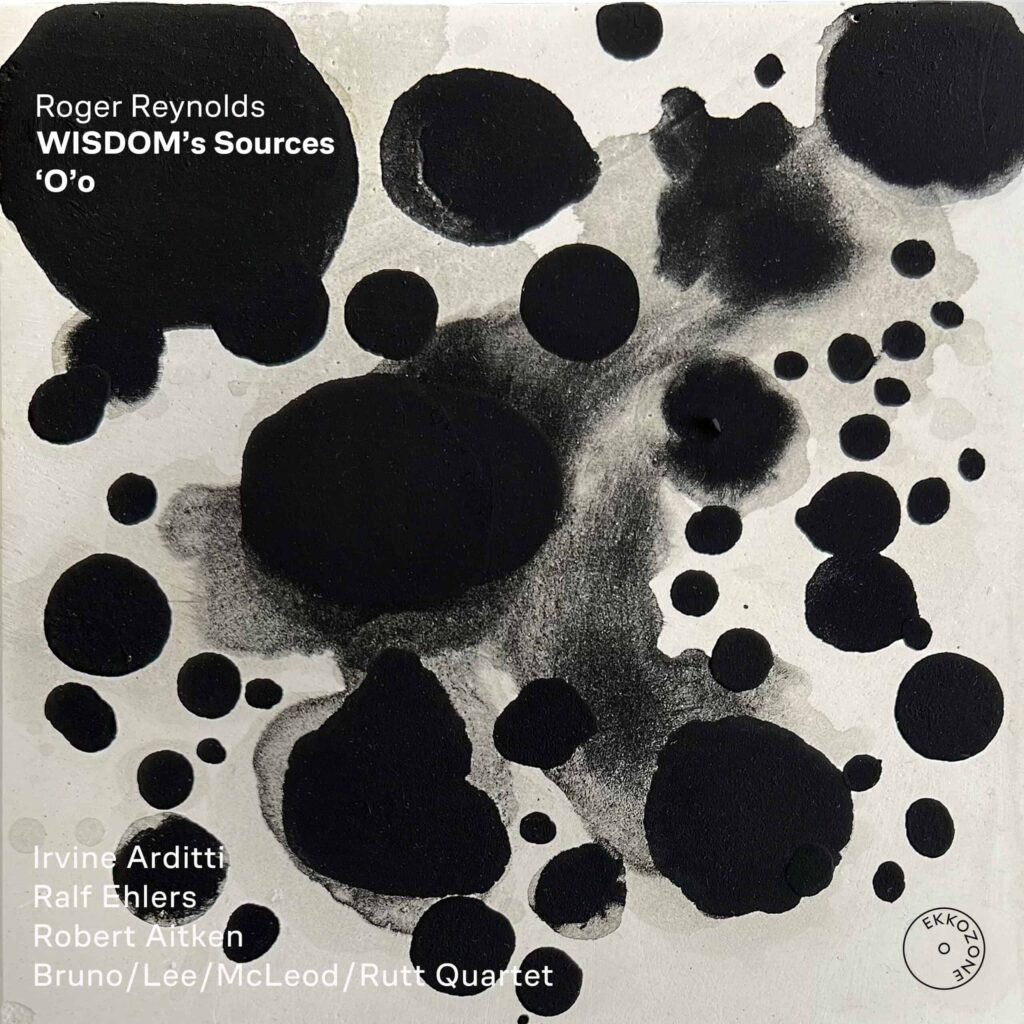
The veteran American composer Roger Reynolds – 91 at the time of this writing – could scarcely have found a more elegant band to bring forth the two highly articulate works on this record: the duo of violinist Irvine Arditti and viola player Ralf Ehlers, compeers from the Arditti Quartet; and the quintet of flute and strings, featuring Reynolds’s longtime friend and collaborator Robert Aitkin.
WISDOM’s Sources, for violin and viola, which leads the track-list, is a three movement showcase of impeccable ensemble playing and vocal gestures by Arditti and Ehlers. The first movement, dedicated to Aeschylus, opens with a severe chorale comprised of heavy double stops, then lightens as whistling Sciarrino-esque harmonic and pizzicato passages make their entry, sometimes with a bit of singing by the duo themselves. Conceived as a video in collaboration with film-maker Kyle Johnson, the work is described as containing a number of performative aspects that are reserved for the camera, though there is also the occasional groan or yell from the duo that is hard not to smirk at, reminiscent of wrestlers on the cusp of pummelling each other (though perhaps some will hear instead the ‘full-body arousal’ by which these sounds are vividly characterised in the booklet note).
The second movement, dedicated to the early 19th-century classic of Tamil poetry and philosophy called the Thirukkural (also known as the Kural), traces the opposite journey, from meditative to insistent, referencing moments from the late Cage work Eight Whiskus. WISDOM’s Sources feels long for a duo work, and the last movement, dedicated to WEB Du Bois, does levy a little patience tax, with the pondering nature of the previous two movements extending itself for another 13 minutes, though one would be remiss not to acknowledge how skilfully Reynolds threads in a tune (specifically Robert Johnson’s ‘Cross Road Blues’) over time.
The quintet ‘O’o, for flute and string quartet, is an attempt to capture both a less common instrumentation as well as the habitat and behaviour of a now-extinct Hawaiian bird species, whose final members, all male, spent their last years crying fruitlessly for mates. The flute is rendered an honorary string player on account of Reynolds’s smart writing, which has the strings often on harmonics or senza vibrato, and the group’s luminescent playing. It is all well hewn if not particularly memorable, though the sensitivity of this rendering may give it staying power.