







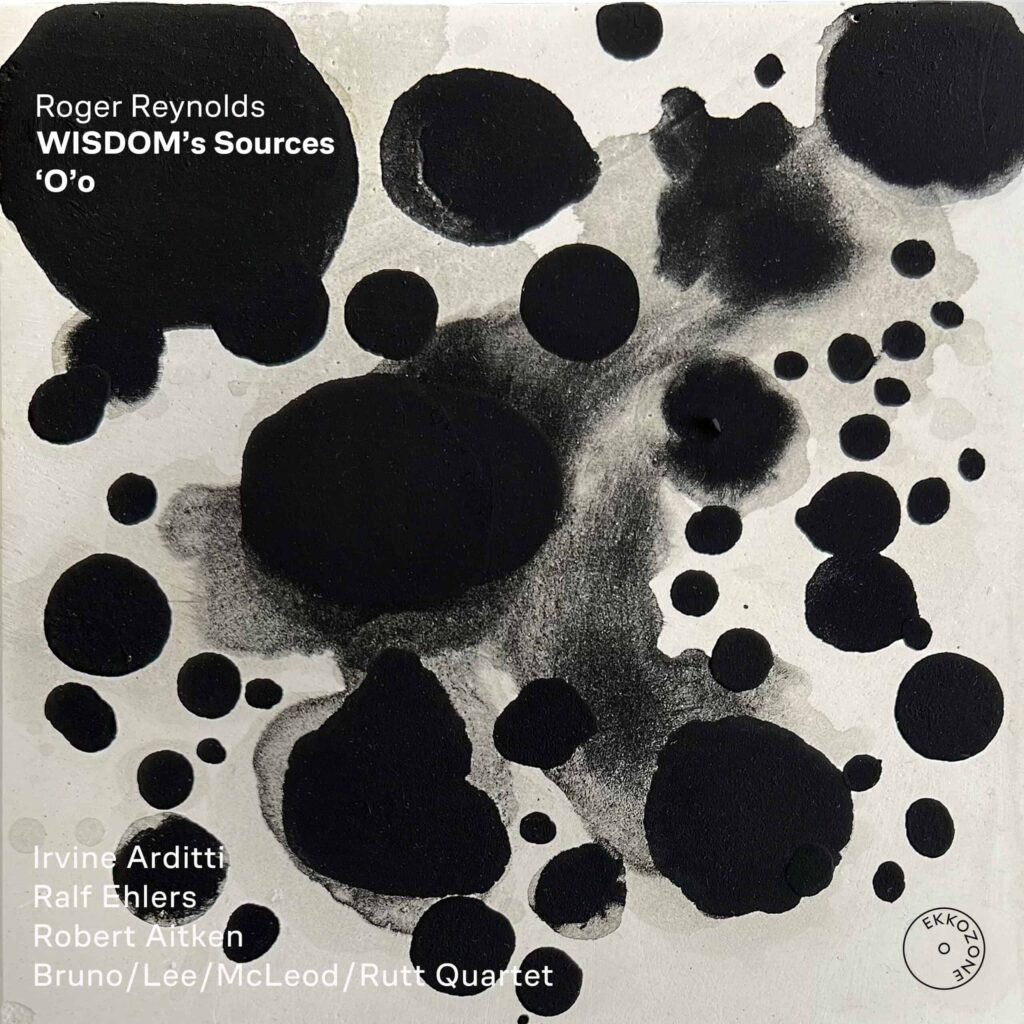
Roger Reynolds: WISDOM’s Sources | ‘O‘o features the performers from that Royal Conservatory concert, Robert Aitken and the Iris Ensemble (Yolanda Bruno, Mark Lee violins, Rory McLeod, viola and Leana Rutt, cello) who worked with Aitken and Reynolds at the Lunenburg Academy of Music Performance in Nova Scotia in advance of this recording. The subject of the mournful work is the extinct Hawaiian ‘O‘o bird, the last known sighting of which was in 1934 on the slopes of Mauna Loa. Programme notes tell us that “Both male and female of this particular species sang to each other, and what made their plight especially poignant was the persistence of the [last] male, who survived another four years after the female died, continuing to sing to his absent mate.” Reynolds found recordings of the ‘O’o’s songs at Cornell University’s Lab of Ornithology and transcribed them. He uses the ensemble to provide “a metaphorical habitat, a sonic environment within which the outlines of a calling and responding would gradually emerge.”
In his 80th year at the time of the recording, Aitken is in top form as he leads a group of fine young players in this emotionally charged, important addition to the flute quintet repertoire.
The disc also includes WISDOM’s Sources, an extended, extremely challenging work for violin and viola, written for Irvine Arditti and his longtime Arditti Quartet colleague Ralf Ehlers. The players are required to “vocalise – without words – and gesture physically” in ways that the composer says “add investment and whole-body arousal.” Composed during COVID with its imposed isolation and resultant frustrations, Reynolds turned to philosophy for inspiration. The first movement is dedicated to the Greek tragedian Aeschylus, the second to the Tirukkural, a classic Tamil text on morality, and the third to the writings of Pan-Africanist civil rights activist W.E.B. Du Bois, specifically his The Souls of Black Folk. I’m afraid I don’t have words to describe this excruciating commentary on that terrible COVID time. It simply must be heard.